

🌐 Audio Networking
Modern professional audio systems increasingly rely on digital networking technologies instead of traditional analog multicore cabling.
Audio networking allows hundreds of audio channels to travel through standard Ethernet cables with extremely low latency and high reliability.
Today, technologies such as Dante, AVB and AES67 are widely used in live sound, broadcast, theatres, conference systems, recording studios and large audiovisual infrastructures.
From Analog to Network Audio
Traditional audio systems required large analog multicore cables between stage boxes, mixing consoles, processors and amplifiers.
Large live productions often involved hundreds of copper audio lines running across long distances.
Digital audio networking changed this completely.
Instead of transporting individual analog signals, modern systems convert audio into digital packets that travel through computer networks.
This dramatically reduces cabling complexity while increasing routing flexibility.
A single Ethernet cable can transport dozens or even hundreds of simultaneous audio channels.
What is Dante?
Dante is one of the most important Audio over IP technologies used in professional AV systems today.
It was developed by Audinate and has become an industry standard for networked digital audio.

Dante allows audio devices such as mixing consoles, DSP processors, wireless systems, amplifiers and stage boxes to communicate over standard IP networks.
One of the biggest advantages of Dante is interoperability between manufacturers.
Devices from different brands can work together within the same network infrastructure.
This flexibility is one of the reasons Dante became extremely popular in professional installations.
Basic Dante Workflow
In a typical Dante system:
- Microphones connect to a digital stage box.
- The stage box converts analog audio into digital network streams.
- Audio travels through Ethernet switches.
- The mixing console receives the channels through the network.
- Processed audio is sent to DSPs, amplifiers or recording systems.
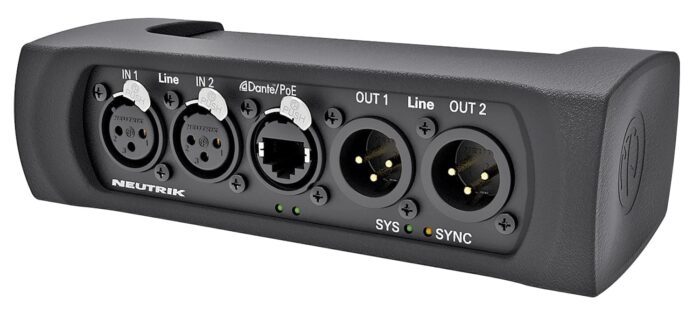
All routing is controlled through software instead of physical patch cables.
This allows extremely fast configuration changes during productions.
Dante Controller
Dante Controller is the software used to manage and route Dante devices.
It provides a matrix view where transmitters and receivers can be connected with simple clicks.
Understanding Dante Controller is essential for professional AV technicians.
The software allows engineers to:
- Route audio channels.
- Monitor device status.
- Check clock synchronization.
- Detect network errors.
- Rename devices and channels.
- Configure redundancy.
Many real-world troubleshooting situations are solved directly inside Dante Controller.
Clock Synchronization
Digital audio devices must share an extremely accurate timing reference called a clock.
If devices are not synchronized correctly, audio clicks, pops or signal instability may appear.
Dante automatically elects one device as the Preferred Master Clock.
All other devices synchronize to that master.
Clock stability is one of the most critical aspects of professional digital audio systems.
Many beginners underestimate how important synchronization really is.
Latency
Latency is the delay between audio entering a system and being reproduced.
Dante systems are designed to operate with extremely low latency values.
Typical Dante latency settings include:
- 0.25 ms
- 0.5 ms
- 1 ms
- 5 ms
Lower latency requires better network conditions.
Large or complex infrastructures may require slightly higher latency settings for stability.
Professional engineers must understand the balance between latency and reliability.
Managed Network Switches
Professional Dante systems should use high-quality managed switches.
Although small systems sometimes operate with unmanaged switches, professional productions require greater control over network behavior.
Important switch features include:
- Gigabit Ethernet ports.
- Quality of Service (QoS).
- IGMP Snooping.
- VLAN support.
- Redundant power supplies.
QoS is especially important because it prioritizes audio packets over less critical network traffic.
Without proper QoS configuration, network congestion can affect audio performance.
Primary and Secondary Networks
Professional Dante systems often use redundant networks.
Each Dante device may have:
- A primary network connection.
- A secondary backup network.
If the primary network fails, audio automatically continues through the secondary path.
This redundancy is critical in broadcast, theatres and large live productions where interruptions are unacceptable.
Common Problems
Audio networking is powerful, but troubleshooting requires both audio and IT knowledge.
Common real-world problems include:
- Incorrect IP addressing.
- Clock synchronization conflicts.
- Network loops.
- Improper switch configuration.
- Damaged Ethernet cables.
- Excessive multicast traffic.
Many technicians entering modern AV environments discover that networking knowledge is now just as important as traditional audio engineering.
Important Tips
When working with network audio systems for the first time:
- Label all devices clearly.
- Keep network diagrams.
- Use certified Ethernet cables.
- Avoid random switch configurations.
- Monitor clock status continuously.
- Understand signal flow before troubleshooting.
Many audio problems in modern productions are actually network problems.
A calm and methodical troubleshooting process is essential.
The Future of Professional Audio
Audio networking continues to expand rapidly across the AV industry.
Large venues, broadcast facilities and touring productions increasingly rely on IP-based infrastructures.
Technicians who understand Dante and professional networking concepts have a major advantage in modern audiovisual careers.
Today, audio engineers are no longer working only with microphones and mixing consoles — they are also managing digital infrastructures and networked systems.