

🎚️ Mixing Consoles
The mixing console is the central element of professional audio systems.
Controls signal levels from microphones, musical instruments, recording systems, effects, and loudspeakers.
Understanding signal flow is one of the most important skills in audiovisual technology and sound engineering.
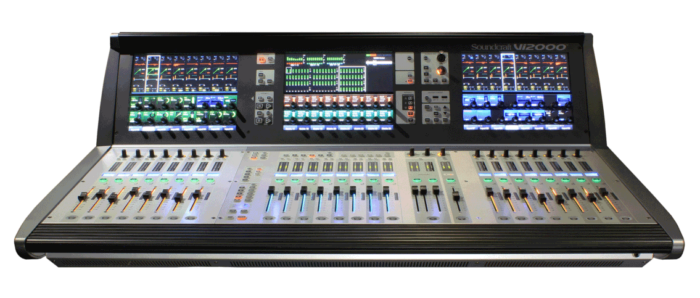
Mixing Console
A mixing console, also called an audio mixer or sound desk, is a device used to combine, process and distribute audio signals. They can be analog or digital.
Audio signal flow
Signal flow describes the path that audio follows through the system.
A typical signal flow might be:
- Microphone or audio source.
- Preamp.
- Equalizer (EQ).
- Dynamics processing.
- Fader.
- Bus routing.
- Amplifier or powered speaker.
Understanding the signal path helps technicians diagnose problems quickly.
Input channels
Each channel on a mixer receives one audio signal.
Typical channel controls include:
- Gain or trim.
- EQ controls.
- Auxiliary sends.
- Pan control.
- Mute button.
- Solo/PFL.
- Fader.
Gain staging
Gain staging is the process of setting correct signal levels throughout the audio system.
Proper gain structure prevents:
- Distortion.
- Clipping.
- Noise.
- Weak signal levels.
The preamp gain should be adjusted carefully before using the channel fader.
Many beginner problems in live sound are caused by incorrect gain staging.
Equalization (EQ)
EQ controls allow technicians to modify frequency ranges.
Common EQ controls include:
- High frequencies.
- Mid frequencies.
- Low frequencies.
- Parametric EQ.
- High / low pass filters.
EQ is used to improve clarity, reduce feedback and balance instruments or voices.
Excessive EQ can damage the natural sound of a mix.
Auxiliary sends and monitor mixes
Auxiliary sends, often called aux sends, are used to create separate mixes.
Common applications:
- Stage monitors.
- In-ear monitoring.
- Effects processors.
- Remote connections.
Musicians on stage often require different monitor mixes depending on what they need to hear.
Buses and subgroups
Buses combine multiple signals into a single output path.
Subgroups help organize channels such as:
- Drums.
- Vocal choirs.
- Orchestra sections.
This simplifies large-scale productions and allows for group signal processing.
Analog and digital mixers
Analog mixers use physical electronic circuits for signal processing.
Digital mixers convert audio into digital data and provide advanced processing features.
Digital consoles often include:
- Internal effects.
- Internal routing matrix.
- Scene memory.
- Remote control.
- Network audio.
- Multitrack recording.
Most modern live productions now use digital consoles.
Common mistakes
- Incorrect gain.
- Too much EQ.
- Ignoring signal routing.
- Bad monitor mixes.
- Overloading outputs.
- Poor channel organization.
Professional engineers develop organized workflows to avoid technical problems during productions.
A skilled audio technician must understand routing, troubleshooting, communication and fast decision-making under pressure.