

🔌 Audio Connectors
and Signal Routing
Audio systems depend on reliable connections.
Knowing the types of cables and connectors is essential for good signal quality.
Why audio connectors are important
All professional audio systems use cables and connectors to carry signals.
Incorrect cable selection or bad routing can introduce noise, hum, interference or signal loss.
A professional technician should know:
- Types of cables and connectors.
- Balanced and unbalanced connections.
- Patch panels and routing systems.
- Stage boxes and multicore cable systems.
Balanced and unbalanced audio
Professional audio systems usually use balanced connections because they reduce electrical interference and noise.
Balanced cables use:
+ Positive signal.
- Negative signal.
⏚ Ground.
Unbalanced connections are more sensitive to noise over long distances.
Examples:
XLR = balanced.
TRS jack = balanced.
TS jack = unbalanced.
RCA = unbalanced.
XLR connectors
The XLR connector is one of the most common professional audio connectors.

It is mainly used for balanced line signals.
XLR connectors are durable, lock securely and provide excellent noise rejection.

Standard 3-pin XLR:
Pin 1 = Ground ⏚
Pin 2 = Positive (+)
Pin 3 = Negative (-)
Jack connectors (TS and TRS)
Jack connectors are widely used in musical instruments, mixers, headphones and audio equipment.

TS (Tip-Sleeve)
=
unbalanced mono.
TRS (Tip-Ring-Sleeve)
=
balanced mono or stereo.
Speakon connectors
Speakon connectors are designed for loudspeaker connections.
They are safer and more reliable than traditional jack speaker connectors.
They can handle high power levels safely.
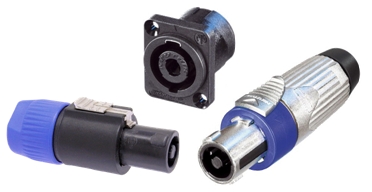
Speakon connectors are used in PA systems, subwoofers, and amplifier racks.
Patch panels and routing
Patch panels organize audio connections in audiovisual installations.
They allow technicians to route signals quickly without reconnecting equipment directly. Large productions may use hundreds of routed signals simultaneously.

Patch panels improve:
- Signal distribution.
- Workflow efficiency.
- Equipment organization.
- Maintenance.
Stage boxes and multicore systems
Live productions often use stage boxes connected through multicore cables.
This allows many microphone signals to travel from the stage to the mixing console using a single cable system.

Cable management and labeling are critical in professional environments.
Common mistakes
- Using unbalanced cables for long distances.
- Incorrect adapter usage.
- Poor cable organization.
- Ground loop problems.
- Damaged connectors or cables.